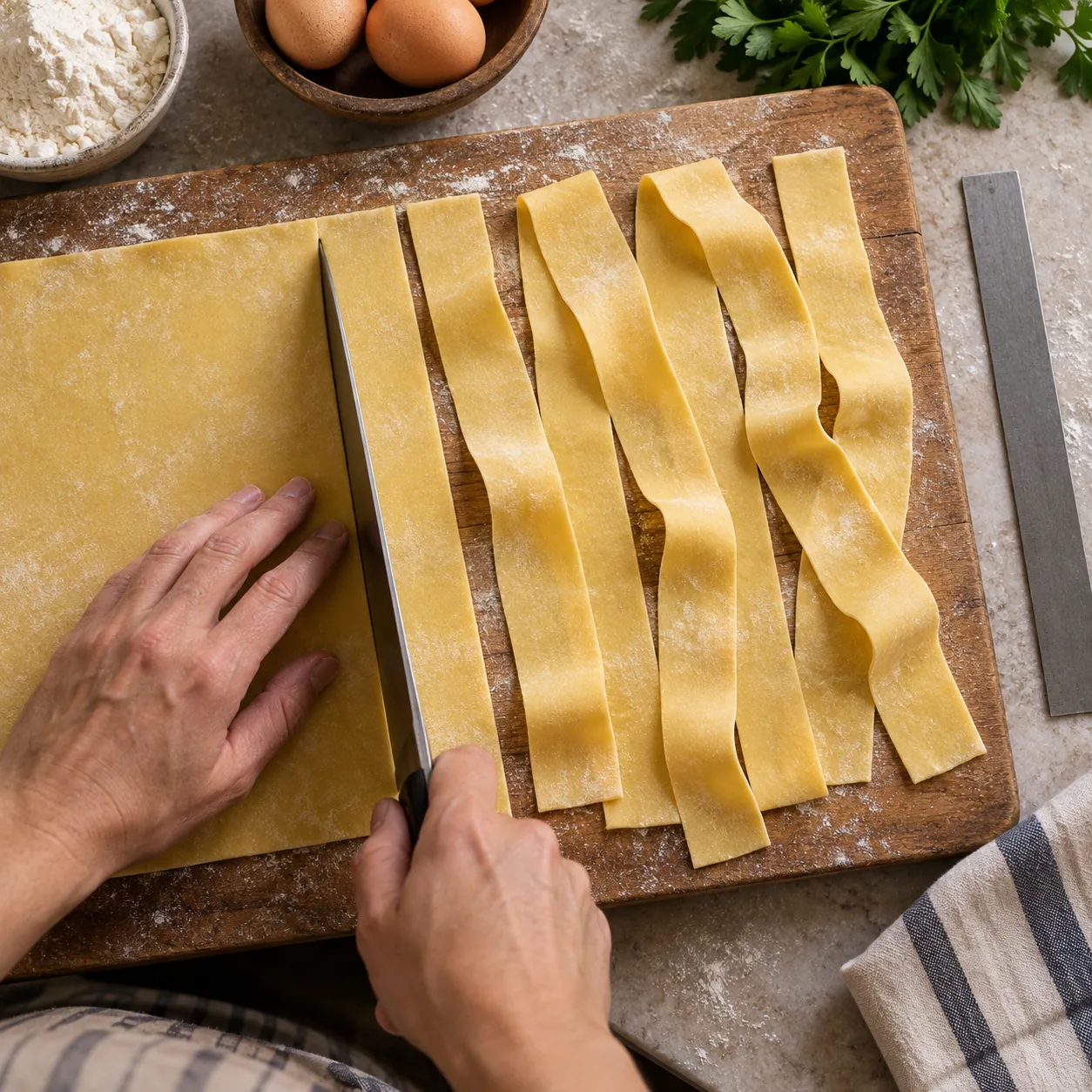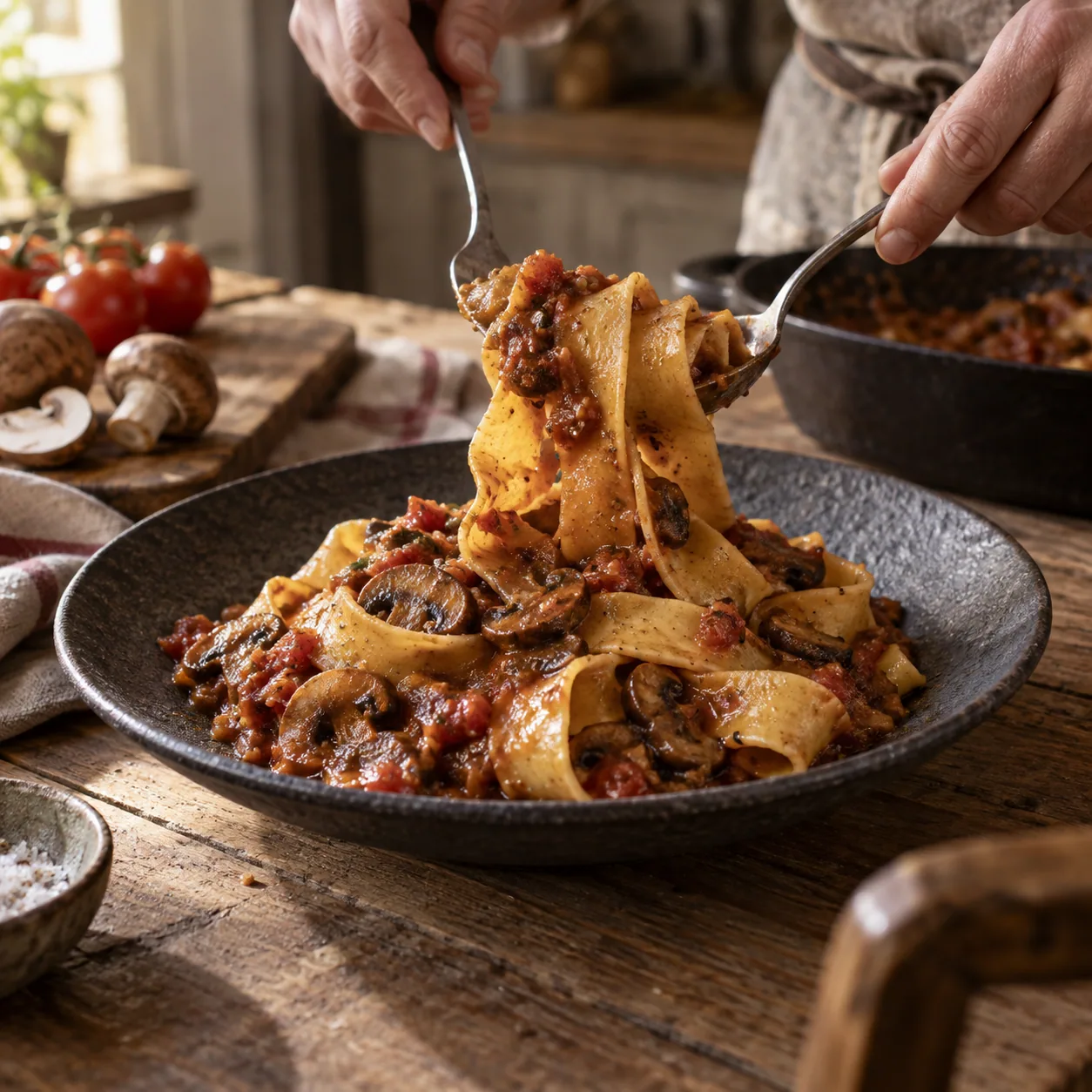
For rustic hand-cut pappardelle, let the cut edge vary slightly while keeping the sheet itself reasonably even. Roll one portion from the center toward both ends, check the sheet before folding it, and use about a 3/4-inch ribbon as the worked example from King Arthur Baking’s hand-rolling guide.
This article uses King Arthur’s Fresh Pasta dough and its rolling-pin method. The measurements and 3-to-4-minute cooking time below belong to that recipe. If you start with another tested dough, keep its rest, thickness, dusting, and cooking directions together.
Roll for even thickness, not a perfect outline
Divide the prepared dough as the recipe directs and keep the unused portion covered. With a rolling pin, begin at the middle of the piece and roll away from you; return to the middle and roll toward you. Continue all the way to each edge so the sheet becomes thin without leaving a heavy center.
King Arthur’s hand-rolling guide aims for roughly 1 millimeter. It also says a slightly thinner or thicker sheet can work. Use that number as a cue for its recipe, not a universal law for every flour and shape.
Before cutting, inspect two different qualities:
- Perimeter: a wavy outer edge changes the silhouette of the ribbon.
- Sheet thickness: a heavy ridge changes how the center and edge cook.
Rustic cutting can keep the first difference. If the center is visibly heavier than the sides, continue the source method’s center-to-edge rolling before treating the sheet as ready.
Use the source’s readiness cues
The guide offers two visual checks. A thin sheet should ruffle when air is blown across it at table height, and light should be visible through it when held up. It also allows a thicker target—about the thickness of a quarter—when a more robust noodle is intended.
Choose one target for the portion rather than making one side translucent and the other coin-thick. These checks do not replace the complete dough recipe, but they make “thin enough” more observable than judging only by the irregular outline.
Fold loosely and cut a wide ribbon
Use a bench knife to divide the sheet into the guide’s 12-inch lengths. Lightly coat one length with flour or semolina, roll it loosely, and cut it with a sharp chef’s knife. King Arthur gives about 3/4 inch as its pappardelle example, compared with narrower widths for fettuccine and linguine.
Unroll every ribbon after cutting. A slight change in edge angle is compatible with the rustic goal; a section that remains folded or attached is a separation problem, not decorative variation.
Move each cut portion to the tray
Place the unrolled ribbons on a flour- or semolina-dusted baking sheet and toss lightly as the guide directs. Keep the next sheet off the finished ribbons so you can still see and lift individual pieces.
The matching Fresh Pasta recipe forms lightly coated noodles into loose mounds on a parchment-lined sheet. Whether you use a loose mound or a flatter arrangement, do not compress the ribbons into a block simply to make the tray look orderly.
Cook by the dough recipe, then compare center and edge
King Arthur’s Fresh Pasta recipe adds the noodles to 4 quarts of salted boiling water, stirs, and boils gently for 3 to 4 minutes. That is a recipe-specific range, not a general pappardelle timer.
Taste a ribbon according to that recipe and compare its center with its edge. If both have a similar bite, the rustic edge did not prevent an even result. If the center remains noticeably heavier, record the sheet-thickness issue for the next portion rather than narrowing the ribbon and changing two variables at once.
Pasta By Hand has not kitchen-tested this pappardelle guide. Its AI illustrations are not photographs of the stated thickness or cooked result.